
Table of Contents
Why Real Estate Agents Skip CRMs for Email
Canadian real estate agents favor email over CRMs for speed, searchable records, lower cost, legal compliance and AI-driven automation.

Why Real Estate Agents Skip CRMs for Email
Real estate agents often rely on email instead of CRMs for managing their work. Here's why:
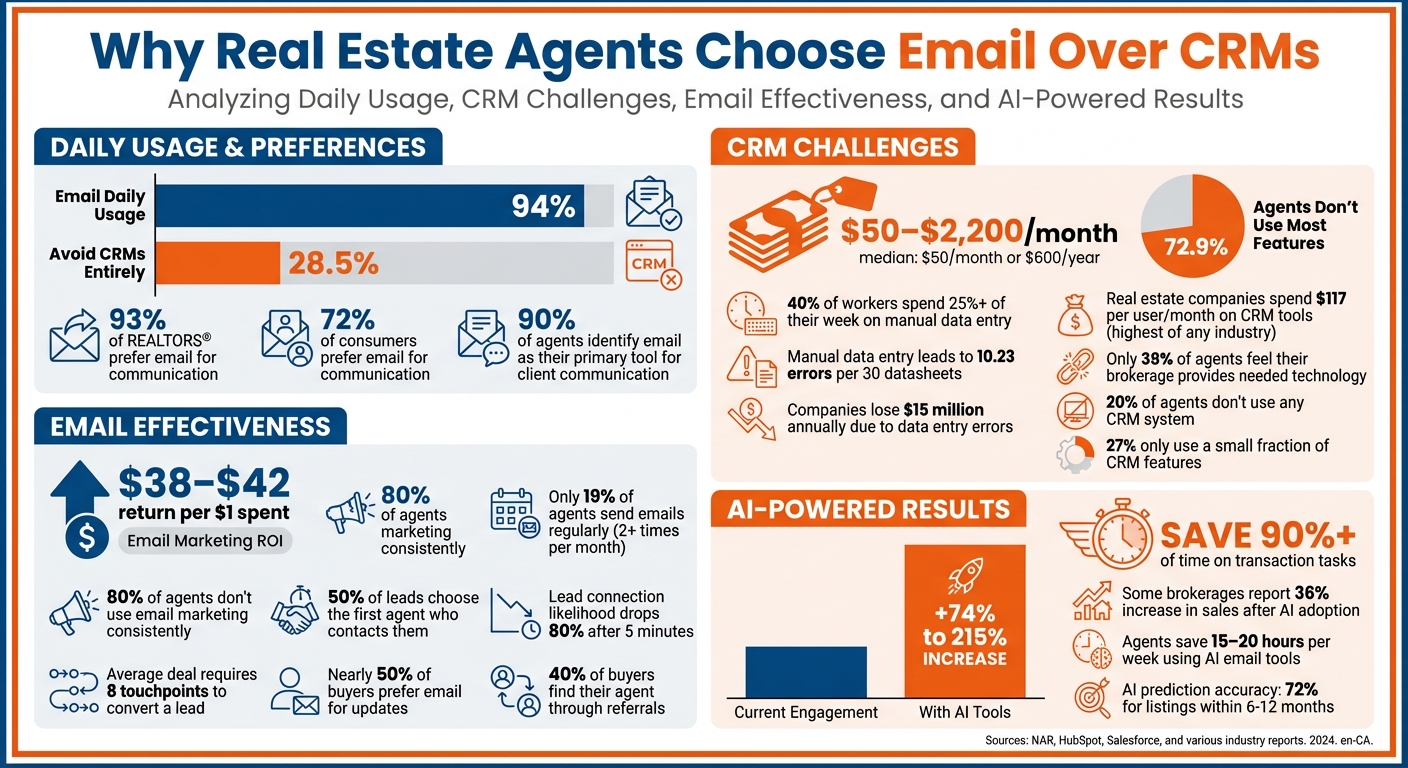
- Daily Use: 94% of Canadian agents use email daily, while 28.5% avoid CRMs entirely.
- Client Preference: 93% of REALTORS® and 72% of consumers prefer email for communication.
- Cost and Complexity: CRMs cost $50–$2,200/month and require time-consuming setup, with 72.9% of agents not using most features.
- Efficiency: Email is faster, easier to search, and better for keeping records, reducing errors common with manual CRM data entry.
- Legal Benefits: Brokerage-provided email ensures compliance with Errors and Omissions insurance.
- Missed Potential: Despite email marketing offering $38–$42 ROI per $1 spent, 80% of agents don’t use it consistently.
AI tools now make email even more effective by automating tasks like follow-ups, reminders, and transaction timelines - all without the hassle of managing a CRM.
Email Success as a Realtor: CRM vs. Email Marketing Explained
Research Findings: Why Agents Choose Email Over CRMs
Studies show that agents often prefer email because of its practical benefits and the challenges associated with CRM systems.
Email as the Core of Real Estate Work
Email is at the heart of an agent's daily operations. A striking 90% of agents identify email as their primary tool for client communication 8. It's invaluable for keeping records of deals and quickly accessing transaction details.
Nicole Beauchamp, a Broker at Engel & Völkers Americas, explains why email remains her go-to tool:
"I still love email as a generally easier trail. Some of the other platforms are harder to search and archive, and sometimes there are just too many possible inputs - it can be very frustrating trying to track down which platform a conversation took place in." 1
Unlike social media platforms, which use algorithms to control visibility 56, email ensures direct and reliable access to a client’s inbox. Clients don’t need to learn or adapt to a specific platform, which makes email a straightforward and effective way to communicate. However, while email is simple and efficient, CRM systems often come with hidden costs and time-consuming requirements.
The True Cost of CRM Setup and Maintenance
Investing in a CRM doesn't stop at the subscription fee. The median cost of a CRM is around $50 per month (or $600 annually), but high-end systems can soar to $2,200 per month 4. Beyond the price tag, there’s the time and effort spent on learning and maintaining these systems, which can pull agents away from focusing on their clients.
Interestingly, 72.9% of agents using CRMs admit they don’t use many of the features available 4. For a profession where 66% of REALTORS® adopt new technology to save time 7, a tool that demands constant attention can feel more like a hindrance than a help.
Strengthening Client Relationships Through Email
Email is a powerful tool for fostering genuine, personalized connections. It allows agents to deliver timely updates or market insights while maintaining a personal touch 1211. Yet, only 19% of agents send emails regularly (at least twice a month) 5. This missed opportunity can have a big financial impact - a single lost referral due to poor follow-up could cost an agent $10,000 to $15,000 in earnings 5.
What makes email stand out is its flexibility. Agents can tailor their communication to suit each client’s preferences. Some clients may appreciate detailed market reports, while others might prefer brief updates. This adaptability is hard to match with CRM systems, which often rely on rigid templates and standardized workflows that can feel impersonal.
Where Traditional CRMs Fall Short
CRMs often fail to meet the practical, day-to-day needs of real estate agents.
The Manual Data Entry Problem
Did you know over 40% of workers spend at least a quarter of their week on repetitive manual data entry? This isn't just a time sink - it leads to an average of 10.23 errors per 30 datasheets, which can completely derail transactions 1617. Imagine losing a potential client because of a typo in a phone number or watching a deal fall apart due to incorrect details. These mistakes add up, costing companies a staggering $15 million annually in losses 16.
Chuck Richards, Senior Product Manager at Real Geeks, summed up the frustration agents feel:
"Too little setup, and your CRM never works at full potential. Too much tinkering, and you spend more time managing the system than working with clients." 3
On top of that, many legacy CRMs don’t sync seamlessly with essential tools like email or MLS platforms. This forces agents to input the same data multiple times across different systems - a tedious redundancy that eats into productivity and, ultimately, their earnings 915. These inefficiencies create a ripple effect, causing broader workflow issues.
Difficult Setup and Workflow Conflicts
Another major issue? Traditional CRMs often clash with how agents prefer to work. Most agents spend the majority of their time in their email inbox, yet many CRMs require constant switching between platforms. This disconnect creates resistance, especially for agents who've had bad experiences with overly complex systems in the past 3.
The steep learning curve adds another layer of frustration. When 66% of REALTORS® adopt new technology specifically to save time 7, a tool that demands hours of setup and ongoing maintenance defeats the purpose. Generic platforms like Salesforce or HubSpot often require heavy customization to handle the specific needs of real estate tasks 14. Without this tailored setup, agents are left with systems that feel clunky and irrelevant, leading to prolonged setup times and constant adjustments. It's no wonder many agents gravitate toward simpler, email-based systems that better align with their workflows.
Why Agents Stop Using CRMs
These challenges push many agents to abandon CRMs altogether. Nearly 20% of real estate agents don’t use any CRM system, while another 27% only use a small fraction of the features available 13. That means almost half of all agents either avoid CRMs entirely or barely engage with them.
The overwhelming burden of manual data entry and confusing workflows makes CRM management feel like an unnecessary distraction. Agents naturally prioritize immediate needs - like returning client calls, scheduling showings, and negotiating offers - over the long-term benefits of automation. As a result, CRMs often get sidelined.
Here’s the kicker: real estate companies spend an average of $117 per user every month on CRM tools - more than any other industry 14. Yet, only 38% of agents feel their brokerage provides the technology they need to succeed 7. This disconnect between investment and satisfaction underscores why so many agents stick to email-driven workflows that better support their day-to-day operations.
Why Email-Based Transaction Management Works Better
Managing transactions through email offers a practical and user-friendly alternative to complex manual CRM systems. By integrating seamlessly into agents' daily routines, email-based workflows simplify real estate transactions. This approach supports faster responses, minimizes errors, and strengthens client communication, making it an essential tool for real estate professionals.
Speed and Efficiency
In real estate, speed is everything. Statistics show that 50% of leads choose to work with the first agent or company that contacts them, and the likelihood of connecting with a lead drops by 80% after just five minutes 2. Email automation steps in to bridge this gap, enabling agents to respond instantly and maintain momentum. As Realtor.com explains:
"Automated emails are like your personal assistant, working behind the scenes 24/7 to keep you connected, nurture relationships, and make sure no opportunity slips through the cracks" 18.
Using email templates for follow-ups and milestone updates ensures timely communication without unnecessary effort. J. D'Ann Melnick, Broker at eXp Realty, highlights this benefit:
"For process and timeline stuff, I generally stick to email so things can be in writing and they can reference back... I have templates set up to accomplish those milestone emails" 1.
Given that the average deal requires eight touchpoints to convert a lead 2, these time-saving tools quickly prove their worth.
Fewer Mistakes and Better Accuracy
Email's centralized nature helps reduce errors by keeping all transaction-related information - contracts, disclosures, timelines, and client preferences - in organized, searchable threads. Nicole Beauchamp, Broker at Engel & Völkers Americas, emphasizes this advantage:
"I still love email as a generally easier trail. Some of the other platforms are harder to search and archive... it can be very frustrating trying to track down which platform a conversation took place in" 1.
Additionally, some brokerage Errors and Omissions insurance policies require agents to use official brokerage-provided email for transaction documentation. This makes email not only convenient but also a safer option compared to third-party messaging apps 1. With fewer mishaps and better access to records, agents can dedicate more energy to serving their clients effectively.
Better Client Communication
Email aligns with how clients prefer to communicate. In fact, nearly 50% of buyers rely on email as their go-to method for receiving updates 2. Unlike CRM portals that require clients to learn new systems or remember login details, email reaches them directly in their inbox, blending seamlessly into their daily routines.
This ease of access fosters a more personal approach to communication, which is key in an industry where 40% of buyers find their agent through referrals 18. By categorizing their contact lists - such as first-time buyers, investors, or sellers - agents can send tailored content that reinforces their expertise and professionalism. However, only 19% of agents send emails consistently (twice a month or more), meaning 80% miss out on the benefits of regular email outreach 5. Considering that email marketing delivers the highest return on investment across channels 5, maintaining consistent contact is a low-maintenance way to build trust and strengthen relationships over time.
AI-Powered Email Tools for Real Estate Agents
AI is transforming how real estate agents manage their email workflows, automating repetitive tasks while maintaining the personal connections that drive their business. By integrating directly with your email inbox, these tools analyze conversations, extract valuable insights, and handle routine tasks automatically. This means less manual effort and more time to focus on building client relationships.
Relationship Intelligence from Email Analysis
AI tools dig into your email history to uncover patterns and identify opportunities. They create detailed client profiles, track the progress of transactions, and even remind you when it’s time to reconnect with past clients. For example, they can recognize commitments like "send contract" or "schedule showing" in your email threads and turn them into actionable tasks25.
These tools go beyond task management by gauging lead intent. They pick up on subtle cues in emails, such as budget discussions, timing preferences, or neighbourhood mentions2324. Some platforms, like Smartzip, even predict which homeowners might sell soon, achieving an accuracy rate of 72% for listings expected within six to 12 months19. Jen Jones, VP at BHHS Homesale Realty, highlights this convenience:
"Cloze is just synching your calls and texts, and logging all of that activity for you. There's no need to remember that you haven't talked to this person for a while - it just tells you to keep in touch." 21
Automation Without Extra Work
AI tools take on the heavy lifting of transaction management. For instance, ListedKit AI can pull key dates from a purchase agreement and create a timeline that syncs directly with your Google Calendar20. This kind of automation has allowed agents to save over 90% of their time on transaction-related tasks22. KivoAI takes it a step further by sending reminders for client birthdays, transaction anniversaries, and follow-ups, complete with AI-generated draft messages you can review and tweak before sending. Rod Messick, CEO at Berkshire Hathaway HomeServices Homesale Realty, puts it simply:
"It's really more a productivity tool than it is a traditional CRM." 21
This combination of time-saving features and ease of use ensures agents can focus on what matters most - serving their clients.
Keeping Client Relationships Personal
AI doesn’t just save time; it enhances the personal touch that’s so crucial in real estate. Tools like KivoAI can draft emails tailored to the context of your past conversations, allowing you to fine-tune the tone with a click before sending. This eliminates the stress of starting from scratch while keeping you in control of every message.
The results speak for themselves: agents using AI-powered tools have seen client engagement increase by 74% to 215%, with some brokerages reporting a 36% bump in overall sales after adoption21. Kathy Ripps, a Realtor at Kuper Sotheby's International Realty, shared her experience:
"They listed with me because Cloze recommended I reach out." 21
Conclusion: Why Simple Tools Win in Real Estate
Research highlights why email continues to dominate in real estate: it's already part of agents' daily routines. It provides the permanent records needed for Errors and Omissions insurance1, ensures agents retain full control over their contact lists - unlike social media platforms that limit visibility through algorithms6 - and makes it easy to search and archive past communications when needed1.
Traditional CRMs often require complicated setup and ongoing maintenance, which explains why 40% of agents bypass broker-provided tools entirely10. This gap underscores the demand for a simpler solution that works seamlessly within existing email workflows.
AI-driven tools step in to optimize your inbox without introducing a new system. They organize contacts automatically, identify tasks buried in conversations, and craft personalized follow-ups that align with your communication style - all without requiring agents to manually log every interaction25. This eliminates the tech hurdles that discourage CRM adoption while preserving the personal touch crucial for closing deals.
The benefits are clear. Agents using these tools can save 15–20 hours per week and respond to leads within five minutes, significantly boosting conversion rates142. With 80% of agents not sending regular emails, those who embrace this approach gain a substantial competitive advantage5.
The takeaway? The simplest tools often win. Email effortlessly handles communication, documentation, and client management. By integrating AI to analyse conversations, uncover opportunities, and draft responses, your inbox evolves into a powerful relationship-building tool - without the complexity of traditional CRMs. In a competitive industry where speed, precision, and genuine connections matter most, simplicity is the ultimate edge.
FAQs
Tags
Ready to fix follow-up?
Try inbox-first relationship management free for 14 days. No credit card required.
Start Free Trial