
Table of Contents
Comparing Manual Tracking and Smart Client Engagement Strategies
Compare manual spreadsheets vs automated client engagement for real estate: save 100+ hours, scale lead management, reduce errors and boost retention.

Comparing Manual Tracking and Smart Client Engagement Strategies
Real estate agents lose time, clients, and money using outdated systems. Manual tracking tools like spreadsheets and sticky notes can’t keep up with growing client lists, leading to missed follow-ups and lost referrals. With 70% of high-income REALTORS®' deals coming from past clients and referrals, staying organized is critical. Automated client engagement tools solve this by saving time, improving accuracy, and boosting client retention through features like automatic email logging and personalized follow-ups.
Key takeaways:
- Manual tracking wastes over 100 hours annually and falls apart with more than 20 leads.
- Automation saves time, manages 50+ leads/month, and improves data accuracy.
- Agents using automation see higher retention and referral rates, driving more deals.
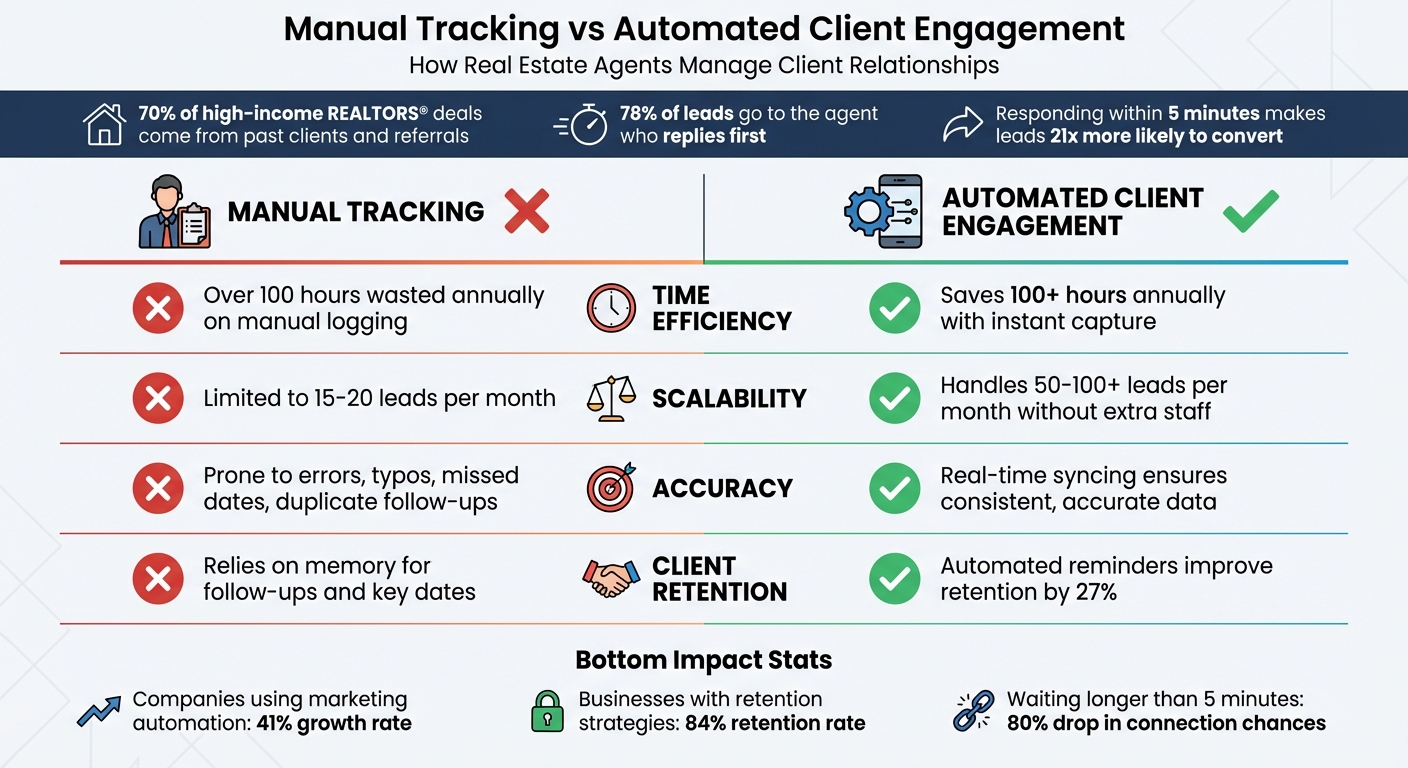
Quick Comparison
| Feature | Manual Tracking | Automated Engagement |
|---|---|---|
| Time Efficiency | Over 100 hours wasted annually | Saves 100+ hours annually |
| Scalability | Limited to 15–20 leads/month | Handles 50–100+ leads/month |
| Accuracy | Prone to errors and duplication | Real-time syncing, no errors |
| Client Retention | Relies on memory for follow-ups | Automated reminders boost engagement |
Bottom line: Automation isn’t optional - it’s the smarter way to manage client relationships and grow your real estate business.
Real Estate Lead Automation: Build a System
1. Manual Tracking
Many Canadian real estate agents still rely on a mix of spreadsheets, sticky notes, and WhatsApp threads to manage their business. This patchwork system scatters data across multiple platforms, leaving no single, reliable source of truth 14. The result? Hours wasted searching for old conversations, duplicate follow-ups, and a constant sense of scrambling to stay on top of things.
The challenges of manual tracking become glaringly obvious when you break it down.
Efficiency
Manual tracking eats up precious time. Logging a single email might take 30 seconds, but for an agent managing 50 emails a day, that adds up to over 100 hours of admin work annually 7. That’s time that could be spent building relationships with clients. Without real-time alerts, agents are left relying on memory, which increases the risk of missed opportunities 1.
Scalability
There’s a hard limit to how much manual systems can handle. Once an agent is juggling more than 15 to 20 leads in a month, things start to fall apart 1. Appointments get missed, follow-ups are forgotten, and the entire system collapses into what some call "administrative paralysis" 7. This makes it clear why so many agents eventually turn to automated tools.
Accuracy
Mistakes are inevitable when relying on manual entry. Names get misspelled, dates are overlooked, and conversation threads are misplaced 7. Without a centralised system, agents often find themselves working with outdated information or accidentally following up with the same client twice 1. These errors don’t just waste time - they can tarnish an agent's professional reputation.
Client Retention
The biggest downside of manual tracking? Losing touch with past clients. With so much focus on data entry and managing new leads, maintaining relationships after a deal closes often falls by the wayside 2. Yet, keeping past clients engaged is far more cost-effective than finding new ones. In fact, 7 out of 10 deals for high-earning REALTORS® come from referrals and repeat business 2. Manual systems also fail to catch key moments - like home anniversaries or life changes - that could indicate a client is ready to move again 26. The result? Missed referrals and lost commissions that could have been captured with a more reliable system.
These inefficiencies highlight why automated client engagement tools are becoming essential for agents looking to stay competitive.
2. Automated Client Engagement (KivoAI)
Modern relationship intelligence tools are changing the way agents interact with clients. These systems can automatically capture emails, organize client information, and identify timely opportunities to engage.
Efficiency
Automation takes care of the tedious tasks that often eat up an agent's day. With two-way synchronization to platforms like Gmail or Outlook, every email is logged automatically - no more manual data entry 7. For an agent managing around 50 emails daily, this can save a huge chunk of administrative time 7. Plus, automated systems can respond to new inquiries instantly, a crucial advantage when 78% of leads go to the agent who replies first 9. Responding within five minutes makes a lead 21 times more likely to convert 9. Wait any longer, and the chances of making a connection plummet by 80% 8. These time-saving measures don’t just reduce routine work - they also make it easier to manage an increasing number of leads.
Scalability
Unlike manual processes that limit how many leads an agent can handle, automated systems allow for seamless expansion. While manual tracking might work for 15 to 20 leads, automation lets agents handle 50 to 100+ new leads per month without needing to hire extra staff 19. Leads from websites, social media, and property portals all feed into one dashboard. AI-powered scoring even prioritizes prospects based on actions like opening emails or saving properties 110. This means agents can focus on the most promising opportunities instead of drowning in data entry.
Accuracy
Automation also improves accuracy by pulling information directly from the source. This eliminates typos and missed details that often occur with manual systems 7. A side-panel view provides a full client profile, including budget, interests, and pipeline stage, so agents always have the right information at their fingertips 7. Personalization tokens ensure that mass communications feel tailored, pulling correct names and details straight from the database. This helps avoid embarrassing mistakes, making every interaction feel professional and personal 7.
Client Retention
Keeping in touch with past clients becomes simple when the system automatically tracks milestones like home anniversaries and birthdays 311. Automated follow-ups can also be triggered when clients revisit listings or hit key milestones 12. Since referrals and repeat business are the bread and butter for top-performing REALTORS® 2, these automated touchpoints help turn past clients into loyal advocates. Companies using marketing automation often see a 41% growth rate 10, and businesses with formal retention strategies average an 84% retention rate 2. Automation doesn’t replace the personal touch - it strengthens it, ensuring relationships are maintained over time.
Pros and Cons
Let’s dive into the strengths and weaknesses of manual and automated methods, building on the earlier points.
When deciding between manual tracking or automation, it’s important to weigh the specific advantages of each. Manual methods - like spreadsheets, notebooks, or sticky notes - are great for getting started but tend to falter as the number of leads grows. On the other hand, automated systems can passively capture emails by syncing directly with tools like Gmail or Outlook, ensuring client profiles are updated in real time. Here’s a critical stat: responding to a lead within five minutes makes them nine times more likely to engage5. Miss that window, and your chances of connecting can plummet by as much as 80%8. Manual tracking often can’t keep up with that kind of urgency.
| Feature | Manual Tracking | Automated Engagement |
|---|---|---|
| Time Efficiency | Over 100 hours lost annually on manual logging7 | Saves over 100 hours yearly with instant lead capture7 |
| Scalability | Best for managing 15–20 leads per month1 | Scales effortlessly without adding staff1 |
| Accuracy | Prone to errors like typos, missed dates, or duplicate follow-ups1 | Real-time syncing ensures consistent and accurate data1 |
| Client Retention | Relies on memory for key dates like birthdays4 | Automated reminders improve retention by 27%2 |
This side-by-side comparison makes one thing clear: automation doesn’t just save time - it also lays the groundwork for growth. It’s not just about doing things faster; it’s about doing them smarter. For instance, real estate firms using marketing automation report a 41% growth rate10, while businesses with structured retention strategies achieve an average retention rate of 84%2.
As PropTechBuzz aptly puts it, "Automation is not about replacing the human touch. It's about making sure you never forget a name, miss a message, or lose a lead." The real question isn’t whether automation is the way forward - it’s how soon you can start.
Conclusion
Manual tracking may work for handling a small number of leads, but it quickly becomes unmanageable as volumes grow. In fact, it can consume over 100 hours annually 7 and cause up to 78% of leads to slip through the cracks due to poor follow-up 9.
Switching to automation is straightforward and delivers measurable results. Take Canadian agent Jason O'Keefe, for instance. By leveraging automated lead generation and nurturing tools, he closed 45 deals in just eight months after entering a new market between 2023 and 2024 13. Similarly, Save Max Canada adopted conversational AI in 2025, which sped up their lead response rate by 62% without requiring additional staff 12. These examples show how automation can tackle the inefficiencies of manual tracking and streamline operations.
Experts in the field echo this sentiment:
"Automation ensures consistent, personalised communication without adding workload." – Jordan Reyneke, Sales Manager, MRI Software 14
For Canadian real estate professionals, the opportunity to improve client relationships and boost efficiency by removing manual processes is clear. The first step? Start with a tool that integrates directly with Gmail or Outlook to automatically record client interactions. Add instant auto-responses to meet the critical five-minute follow-up window, and segment your database by buyer timelines and preferences. KivoAI’s email-based system eliminates the need for manual data entry, builds dynamic client profiles, and highlights opportunities to reconnect - all while avoiding the complexity of maintaining a traditional CRM.
The real question is: How much longer can you afford to delay automating your processes?
FAQs
Tags
Ready to fix follow-up?
Try inbox-first relationship management free for 14 days. No credit card required.
Start Free Trial