
Table of Contents
Overcoming Challenges in Real Estate Client Engagement
Stop losing clients after closing: use inbox-driven automation to track milestones, prioritize leads, and send personalised follow-ups that grow referrals.

Overcoming Challenges in Real Estate Client Engagement
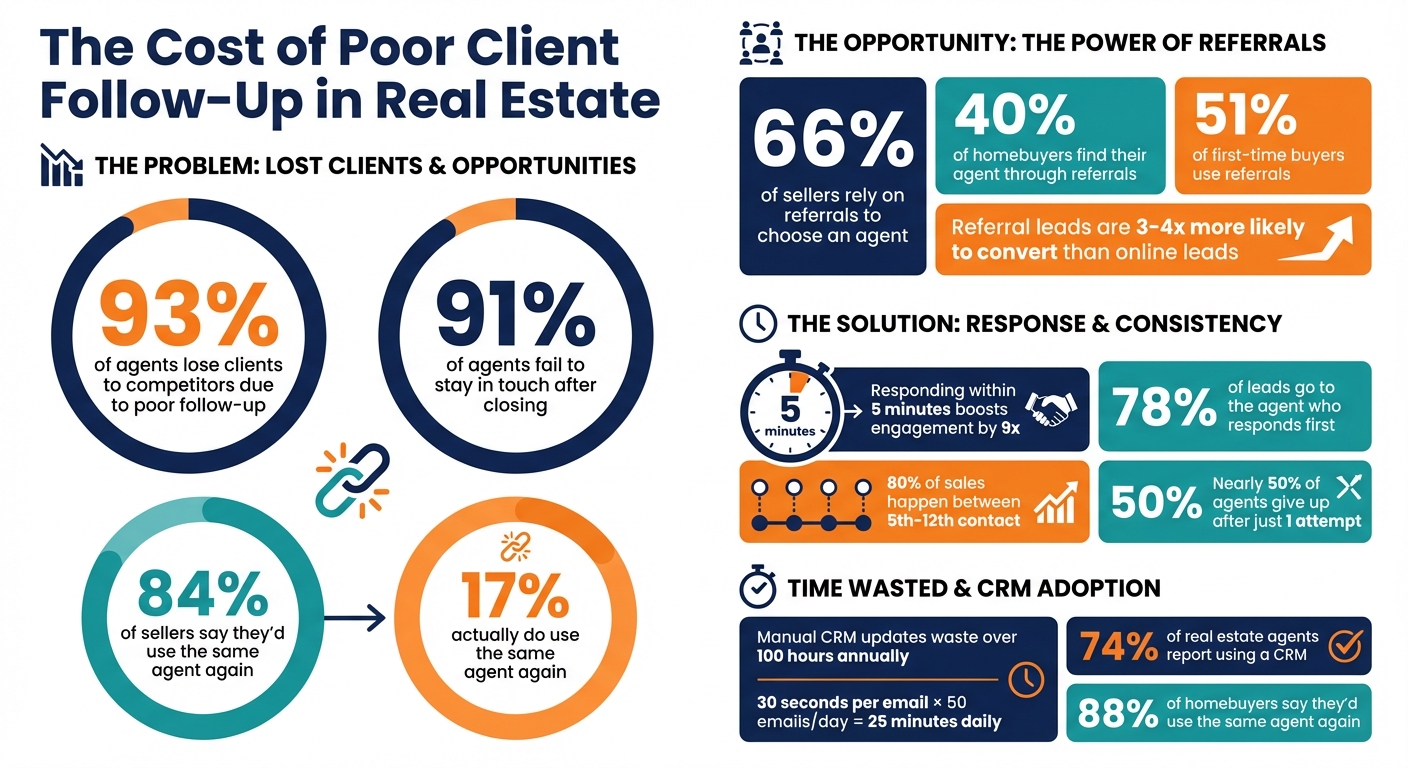
Real estate agents often struggle to maintain client relationships after closing a deal, even though 84% of sellers say they’d use the same agent again. The problem? Many agents prioritize immediate tasks like listings and transactions, neglecting follow-ups that drive referrals and repeat business. Missed opportunities arise from outdated CRMs, manual data entry, and a lack of automated tools that track client behaviour and milestones.
Key Insights:
- 93% of agents lose clients to competitors due to poor follow-up.
- 66% of sellers rely on referrals to choose an agent.
- Responding to leads within 5 minutes boosts engagement by 9x.
- Manual CRM updates waste over 100 hours annually.
Solution: Email-driven tools integrate seamlessly with Gmail or Outlook, automating repetitive tasks like client updates, follow-ups, and milestone tracking. These systems use AI to identify client needs, prioritize leads, and ensure timely, personalized outreach - helping agents build long-term loyalty and boost referrals without extra effort.
Staying connected with clients isn't just about sending emails - it's about consistent, meaningful engagement that keeps you top of mind for years to come.
My Secret Strategies for Client Retention in Real Estate!
Why Traditional CRM Systems Fall Short
Many agents turn to traditional CRM platforms, hoping to streamline client engagement and simplify their workflow. However, these systems often require constant maintenance, pulling agents away from what truly matters - building relationships and closing deals.
Manual Data Entry Eats Up Valuable Time
Most traditional CRMs operate separately from the tools real estate agents rely on daily, like email and property search platforms. This disconnect forces agents to manually transfer data, a time-consuming process. For instance, logging emails into a CRM can take around 30 seconds per email. Multiply that by 50 emails a day, and you're looking at 25 minutes daily - or over 100 hours a year - spent on tedious data entry tasks 4.
"The goal of achieving superior CRM email integration is to eliminate the 'search and switch' paradigm. You should never have to search your inbox for context, then switch to your calendar for availability, and then switch to your CRM to log the action." – AgentAI 4
Texting, another key communication channel for agents, adds to the problem. Traditional CRMs struggle to automatically capture these interactions without manual input 6. Similarly, insights from property search behaviours - like price preferences, neighbourhood interests, or saved listings - often remain locked in IDX systems. This leaves agents without a full understanding of their clients' needs, creating inefficiencies that extend far beyond data entry.
Systems That Don't Fit the Real Estate Workflow
Outdated CRMs not only demand extra work but also fail to adapt to the fast-paced and irregular nature of real estate. Unlike other industries, real estate rarely sticks to a 9-to-5 schedule. Yet many CRMs function more like static address books than dynamic tools capable of tracking client activity in real time 76.
Take this scenario: a lead views a property multiple times late at night - a clear sign of strong interest. Traditional systems often don't alert agents until the next business day, by which time another agent may have already stepped in. With rigid interfaces and cumbersome processes, agents often revert to using sticky notes or spreadsheets instead. While 74% of real estate agents report using a CRM, there’s still a major gap between adoption and effective use 7.
"Manual follow-up isn't just inefficient – it's unsustainable for scaling teams." – RealScout 3
Outdated Data Leads to Missed Opportunities
Even when agents diligently update their CRM, the data can quickly become outdated. Contact details change, and life events - like marriages, career shifts, or family changes - can go unnoticed. Without automated updates, these databases often turn into what some in the industry call "dead-a-bases" 69. Missing these personal milestones can make it harder for agents to build the trust needed for repeat business and referrals.
The cost of this disconnect is steep. While 88% of homebuyers say they’d use the same agent again, only 17% actually do. Why? Because 91% of agents fail to stay in touch after the sale closes 5. This lack of follow-up leaves the door open for competitors to swoop in. If a CRM doesn’t capture key life events - like a client getting married, receiving a job promotion, or becoming empty nesters - agents miss those pivotal moments when clients might need their services again.
| Database Type | Business Impact | Typical Results |
|---|---|---|
| Disorganized List | Missed opportunities, inconsistent follow-up | Unpredictable income, constant prospecting |
| Basic Management | Better follow-up with some relationship tracking | Occasional referrals, some repeat business |
| Strategic System | Systematic nurturing with targeted communication | Consistent referrals, predictable business flow |
These limitations highlight the need for email-driven solutions that transform scattered client data into actionable insights, helping agents stay ahead in a competitive market.
Using Email-Driven Relationship Intelligence
Real estate agents spend a significant part of their day in their inbox - whether it’s managing contract negotiations, responding to buyer inquiries, or arranging property showings. Email-driven relationship intelligence integrates directly with Gmail or Outlook, automatically capturing and organizing client details without disrupting daily workflows.
This method relies on passive data collection. Instead of manually recording every interaction, modern tools scan email histories in the background, linking recipient addresses to contact records and creating a detailed timeline for each relationship 4. By automating these repetitive tasks, agents can focus on more strategic activities 4. The seamless integration also provides a deeper understanding of client interactions, all derived from everyday email exchanges.
Converting Email Conversations into Client Insights
AI tools can uncover valuable patterns hidden in email threads. By analyzing past communications, these systems identify client preferences - such as desired neighbourhoods, price ranges, property types, and must-have features 810. They also monitor engagement signals, like how often clients open emails, click on property links, or respond promptly.
This behavioural tracking helps agents prioritize their leads based on buying intent. For example, a client who frequently clicks on luxury property links and asks about financing options might be flagged as a "Hot" lead, ready to purchase within the next 30 days. Meanwhile, someone casually browsing listings could be categorized for long-term follow-up 810. Considering that 78% of leads go to the agent who responds first and follows up consistently 8, these insights ensure timely and targeted engagement.
"For a real estate agent, the inbox is the central nervous system of their business. Every contract, negotiation, client instruction, and lead inquiry passes through Gmail or Outlook." – AgentAI 4
Building Client Profiles That Update Automatically
Once these insights are gathered, the system keeps client profiles up to date without requiring manual input. Through two-way synchronization, every email is automatically linked to the corresponding client record 4. This creates a unified profile that includes transaction history, important dates (like birthdays or lease expirations), and interaction patterns - all updated in real time.
Many platforms even offer a side panel within your email client, allowing you to access critical client details - such as budget, pipeline stage, property interests, and past conversations - while drafting emails 4. This contextual information ensures you always have the full picture, eliminating the need to search through multiple systems to recall a client’s specific preferences or timeline.
Keeping these profiles current is crucial. For instance, if a client mentions their lease is ending soon, the system instantly flags this milestone 112. Staying connected during these life transitions is key, especially since 40% of buyers find their agent through referrals 2. Maintaining meaningful relationships can turn past clients into repeat customers.
Reducing Manual Work with Inbox-Based Workflows
Email-driven tools also streamline follow-ups by integrating directly into your inbox. Instead of setting reminders or toggling between apps, the system creates tasks based on client behaviour. For example, if a client opens an email multiple times but doesn’t reply, the tool might generate a "Call Task" to prompt personal outreach 4.
This eliminates the inefficiency of constantly switching between apps to check history, schedule follow-ups, or log interactions 4. With inbox-based workflows, everything happens in one place. You can draft personalized follow-ups with AI assistance, tweak the tone with a click, and send messages while staying in control of the communication.
The goal isn’t to flood clients with generic emails but to reach out at the right moment. Whether it’s sharing a listing in their preferred neighbourhood, providing a market update, or acknowledging a special milestone, these tools ensure your outreach is timely and relevant. Since 80% of sales happen between the 5th and 12th contact 12, consistent engagement can make all the difference.
How to Use Tools for Better Client Engagement
Key Features of Inbox-Based Platforms
Inbox-based platforms have become indispensable for real estate agents, tackling common challenges with some game-changing features. For instance, AI tools can whip up engaging subject lines and personalized follow-ups in seconds, eliminating the dreaded writer's block 1015. Behavioural triggers take it a step further by tracking client actions - like repeatedly opening an email, clicking property links, or browsing your website - and suggesting timely follow-ups automatically 101314.
These platforms also enhance client profiles by pulling in social media details, job titles, and interaction history, giving you a well-rounded view of each contact 15. Alerts for milestones like home purchase anniversaries or birthdays ensure you never miss an opportunity to reconnect 21314. Smart scheduling features let clients book showings or calls directly from an email, cutting down on time wasted coordinating back and forth 813. Lead scoring is another standout, helping you identify high-value prospects by analysing engagement patterns - a critical tool when you consider that 80% of sales happen between the 5th and 12th contact, yet nearly half of agents give up after just one attempt 12.
With these tools in your arsenal, the next step is figuring out how to weave them into your daily routine.
How to Integrate These Tools into Your Workflow
Integrating these tools into your workflow doesn’t have to be complicated. Start by focusing on platforms with native connectors for Gmail or Outlook. These are more reliable than third-party solutions, which can sometimes fail after system updates 4. Once connected, set up sync rules to ensure only relevant messages - like those tied to existing contacts or specific folders - are imported, keeping your inbox clutter-free 4.
Since client data is often sensitive, security should be a top priority. Choose platforms that meet strict data privacy standards and allow you to maintain full control over your communication logs 4. Mobile functionality is another must-have, as agents are frequently on the move 4. A helpful feature to look for is a side panel within your email client that displays a client’s full profile - covering details like budget, property preferences, and next steps - without requiring you to switch apps 4.
Instead of automating everything at once, take a phased approach. Begin by automating follow-ups for your busiest lead sources, and gradually expand to long-term nurture campaigns or referral pipelines 121316. Finally, audit your lead sources - whether they originate from Zillow, social media, or client referrals - and link them directly to your platform for seamless tracking 8.
By embedding these tools into your daily operations, you can close the gaps in your follow-up process and maintain consistent client engagement.
Growing Your Referral Business Through Consistent Contact
Once your workflow is running smoothly, these tools can also help you grow your referral business. Referrals are the backbone of a thriving real estate practice. In fact, 40% of homebuyers find their agent through a referral, and this jumps to 51% for first-time buyers. For sellers, the number is even higher - 66% work with an agent they were referred to 2. However, many agents struggle to maintain consistent contact, which is essential for staying top of mind with past clients and their broader network.
Inbox-based tools simplify this by automating regular touchpoints that keep your relationships active. Group your contacts into categories - like VIPs, past clients, and hot leads - so your automated messages remain relevant 814. Pay attention to behavioural signals, such as a client frequently opening market updates or using a home valuation tool. These actions often indicate they’re ready to engage, making it the perfect time to reach out 61415. Additionally, set up reminders to connect with your top referrers at least once a month, ensuring you remain their go-to recommendation 614.
"Relationships are the basis of a successful real estate career." – RealOffice360 6
While automation handles the routine tasks, adding a personal touch can make all the difference. For high-value leads, consider sending video messages or voice notes to stand out 810. Multi-channel follow-up strategies that combine email, SMS, and video can also boost response rates by up to 300% compared to single-channel approaches 12. And since referrals are 3–4 times more likely to convert than online leads 15, consistently nurturing these connections can create a steady stream of referrals, driving long-term growth and strengthening client loyalty.
Conclusion: Building Long-Term Client Relationships with Modern Tools
Succeeding in Canada's real estate market isn't just about finding new leads - it's about strengthening the relationships you already have. Agents striving for long-term success need to move beyond sporadic efforts and embrace consistent, meaningful engagement to stay ahead 1.
Failing to follow up consistently can be costly. A staggering 93% of contacts eventually turn to competitors, and 80% of conversions require at least five interactions 315. This is where automation becomes a game-changer. Modern tools can track key milestones like home anniversaries, analyse client behaviour, and send timely, personalised messages. By replacing guesswork with real-time insights, agents can focus on building trust and delivering value.
For example, automated relationship intelligence alerts you to important client actions - like repeatedly opening market updates or marking a home anniversary. These signals give you the chance to connect in a way that feels personal and thoughtful 11. Since referral leads are three to four times more likely to convert than online leads 15, staying top-of-mind with past clients is one of the smartest strategies for growth. Modern platforms make this easier by simplifying daily tasks, such as updating client profiles, highlighting key inbox insights, and drafting personalised follow-ups.
When agents combine technology with genuine care, they create loyalty that lasts. The Canadian market rewards those who consistently provide value - whether it’s sharing hyper-local market updates or simply checking in on a client’s home anniversary. These small but meaningful touchpoints build trust over time. As Realtor.com PRO puts it, "People remember how you made them feel, not how fast your CRM responded" 11. By adopting tools and workflows that prioritise relationships over transactions, you’re not just staying competitive - you’re building a business that thrives on referrals, loyalty, and long-term success.
FAQs
Tags
Ready to fix follow-up?
Try inbox-first relationship management free for 14 days. No credit card required.
Start Free Trial