
Table of Contents
Automated Segmentation vs. Traditional CRMs
Compare AI-driven automated segmentation with traditional CRMs: real-time lead grouping, fewer manual tasks, faster responses and higher conversions.

Automated Segmentation vs. Traditional CRMs
Managing client relationships efficiently is critical for real estate agents. Automated segmentation and traditional CRMs serve this purpose, but they differ significantly in how they handle client data, follow-ups, and lead management. Here's what you need to know:
- Traditional CRMs rely on manual data entry and static client lists. Agents spend hours daily updating records, qualifying leads, and setting reminders. These systems often lead to outdated data, slow response times, and missed opportunities.
- Automated segmentation uses AI to track client behaviours in real time. It dynamically groups leads, updates profiles automatically, and triggers timely follow-ups. This eliminates repetitive tasks, improves accuracy, and ensures faster responses.
Key benefits of automated segmentation:
- Saves time by removing manual data entry.
- Increases lead conversion rates with predictive insights.
- Reduces response times to as little as 5 minutes.
- Enhances client engagement with personalized outreach.
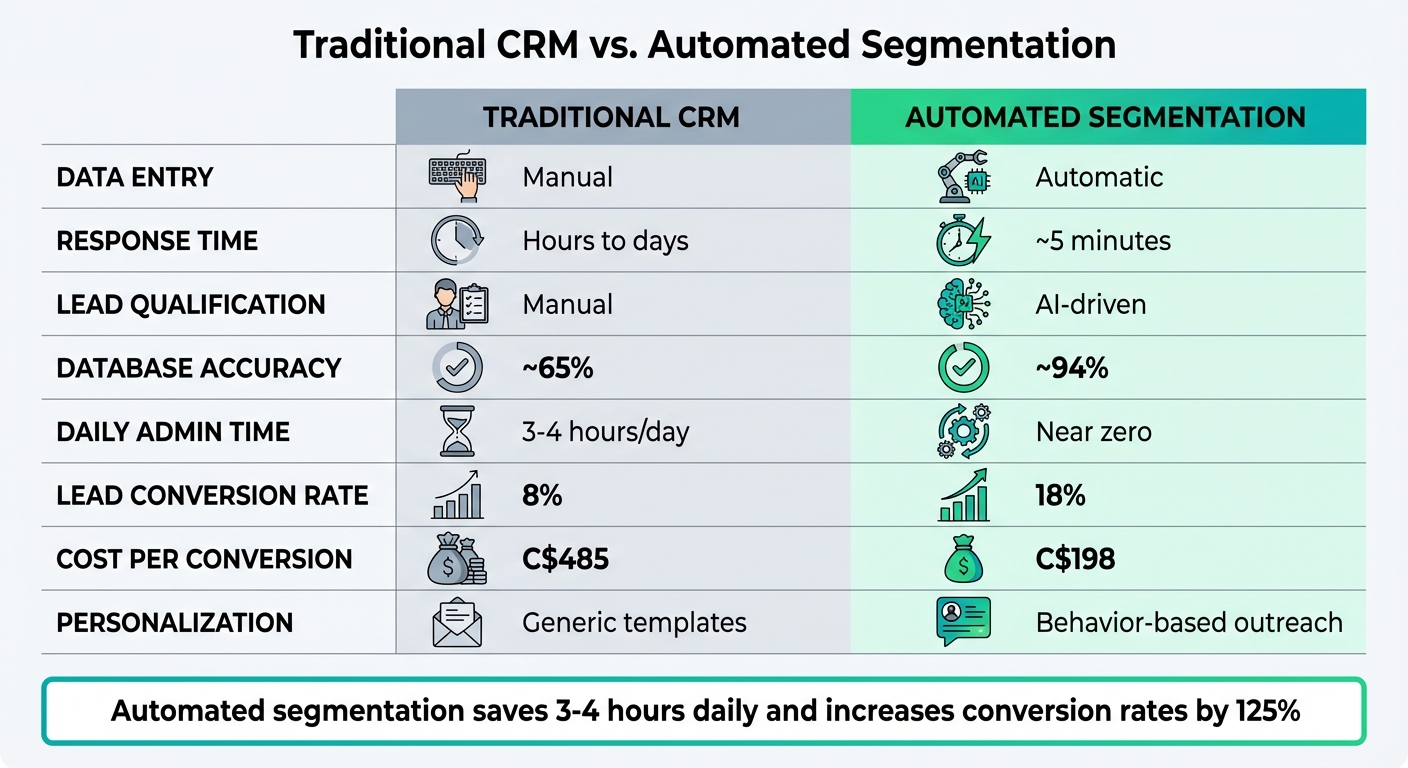
Quick Comparison:
| Feature | Traditional CRMs | Automated Segmentation |
|---|---|---|
| Data Entry | Manual | Automatic |
| Response Time | Hours to days | About 5 minutes |
| Lead Qualification | Manual | AI-driven |
| Personalization | Generic templates | Behaviour-based outreach |
| Database Accuracy | ~65% | ~94% |
Automated segmentation is ideal for agents overwhelmed by admin work or looking to scale their business without hiring more staff. It enables you to focus on building relationships and closing deals while AI handles the repetitive tasks.
How Traditional CRMs Work
Manual Data Entry and Fixed Client Lists
Traditional CRMs rely heavily on manual data entry, requiring agents to input client information like business cards, call logs, and emails by hand. This process isn't just tedious - it's a major time sink. Agents typically spend 3-4 hours daily on administrative tasks, including around 45 minutes entering contacts, 30 minutes updating records, and 90 minutes qualifying leads. For a 10-agent team, that adds up to 30-40 hours of lost selling time every single day.
Human error is another big issue. On average, there's one mistake for every 300 keystrokes. This results in traditional CRMs achieving only about 65% data accuracy, compared to automated systems that can hit 94% accuracy. To make matters worse, as much as 40% of the database in these systems may be outdated or incomplete. This leaves agents making decisions based on flawed or unreliable data, which can seriously impact performance.
Another pain point? Constantly switching between platforms. Most traditional CRMs require agents to leave their email inbox - where they spend the bulk of their time - to update records in an external dashboard. Logging a single email can take 30 seconds, and for an agent handling 50 emails daily, that adds up to about 25 minutes of wasted time.
And while these systems can help with basic task management, their automation tools leave much to be desired.
Basic Automation and Task Management
Traditional CRMs often come with simple automation features, but these are far from dynamic. They typically offer basic "if-then" workflows, such as setting up email drip campaigns or reminders for follow-ups. However, these workflows don't adapt to real-time client behaviours, meaning agents must manually update them to stay relevant.
While tools like calendar syncs and task lists can help agents stay on top of deadlines, they fall short when it comes to addressing urgent client needs. This lack of responsiveness is a major issue, especially since 78% of real estate leads are lost due to slow response times.
The shortcomings of traditional CRMs have real-world consequences. Take the example of the Coastal Living Team in Miami, a 15-agent luxury real estate group. In January 2024, they were using a traditional CRM and managed to convert only 8-10 out of 400 monthly leads. Their Operations Manager, Lisa, spent 50 hours per week manually distributing leads and chasing agents for updates. After upgrading to an automated system that handled lead routing and instant qualification, their lead volume jumped to 600 per month, and conversions nearly tripled to 25-30 clients. This shift boosted their monthly revenue by $420,000.
The difference is clear: traditional CRMs are holding teams back.
Benefits of Automated Segmentation for Real Estate Agents
Real-Time Client Grouping and Insights
Automated segmentation leverages AI to categorize clients based on their current behaviours rather than relying on static, manually entered data. It observes key interactions like time spent viewing listings, saved properties, email opens, and link clicks. This allows it to dynamically identify active searchers, casual browsers, first-time buyers, or seasoned investors.
With this system, you can prioritize leads that show strong engagement. For example, it highlights high-intent clients, helping you focus your outreach efforts where they matter most. In fact, businesses using predictive lead scoring report up to a 77% higher return on investment (ROI) from lead generation compared to those that don't.
The system also ensures that client profiles stay up to date by continuously analysing interactions. While traditional CRM data can become outdated by about 34% annually, automated segmentation keeps information fresh and relevant. This dynamic approach simplifies client management, offering a hands-free way to maintain accuracy.
No Manual Data Entry Required
Beyond providing real-time insights, automated segmentation eliminates the need for manual data entry. AI-powered tools like KivoAI can scan emails to extract important details such as property preferences, budgets, desired school districts, and renovation plans - automatically updating client profiles.
"Traditional CRMs fail because they require you to leave your inbox, the one place you already live." - KivoAI
This inbox-first approach significantly improves data accuracy. By automating these updates, real estate brokers - who often spend as much as 60% of their time on administrative tasks - can dedicate more time to building relationships with their clients.
Side-by-Side Comparison: Ease of Use, Efficiency, and Results
Ease of Use: Manual Input Versus Automated, Hands-Free Operation
The difference in daily workload between traditional CRMs and automated segmentation is stark. With traditional CRMs, agents can spend 45-60 minutes daily manually entering contact details from business cards and emails, 30 minutes updating records after client calls or showings, and over 90 minutes cold calling to qualify leads. That's more than three hours a day on administrative tasks. Automated segmentation, on the other hand, handles these tasks seamlessly - extracting data, syncing records through behaviour tracking, and qualifying leads through natural, AI-driven conversations.
| Task | Traditional CRM (Manual) | Automated Segmentation (Hands-Free) |
|---|---|---|
| Lead Entry | 45-60 mins/day | 0 mins; automatic extraction |
| Record Updates | 30 mins/day | Automatic syncing via behaviour tracking |
| Lead Qualification | 90+ mins/day | 0 mins; AI qualifies leads |
| Follow-up Setup | 20 mins/day per sequence | 0 mins; dynamic triggers based on intent |
Switching between email inboxes and separate CRM dashboards adds even more friction. Adoption rates for traditional CRMs hover below 30% in many brokerages, while AI-driven platforms have achieved adoption rates as high as 90%. By automating repetitive tasks, these platforms simplify operations while improving efficiency and scalability.
Efficiency: Automation Levels and Growth Capacity
Traditional CRMs offer limited automation, such as email templates and calendar reminders, but require manual workflows and provide mostly historical insights. Automated segmentation takes things further with predictive lead scoring, behaviour-based workflows, and hyper-personalized outreach tailored to property views and browsing habits.
The difference is even more apparent under growth pressures. For example, the Coastal Living Team saw a dramatic improvement in conversion rates after adopting automated segmentation. This approach not only streamlines processes but also supports growth without additional hires.
| Capability | Traditional CRM | Automated Segmentation |
|---|---|---|
| Scalability | Capped by agent hours; needs more staff | Handles high inquiry volumes with AI (up to 75% automated) |
| Personalization | Generic email templates | Hyper-personalized outreach based on client activity |
| Intelligence | Historical data only | Predictive insights for next-best actions |
| Response Speed | Hours to days | About 5 minutes |
These efficiency gains lead to faster responses, better client interactions, and more effective relationship management.
Results: Effects on Client Relationships and Referrals
Response time plays a critical role in lead conversion. Traditional CRM users take an average of 2.5 hours to respond to leads, while automated systems can reply in as little as 5 minutes. This quick response window makes it up to 100 times more likely to connect with a lead compared to waiting 30 minutes. Consequently, traditional CRM users convert about 8% of leads into appointments, while AI-powered systems achieve an 18% conversion rate.
Automated segmentation also improves client relationship quality. Traditional CRMs act as passive databases, which can lead to a loss of about 25% of renewing contracts if an agent leaves, due to the lack of contextual relationship data. Automated systems, however, maintain a detailed history of client interactions, enabling personalized follow-ups that reference specific property views, neighbourhood comparisons, or engagement with tools.
Take Metropolitan Realty Group, for example. This 25-agent team in Seattle implemented an AI CRM in early 2024 to reduce agent burnout. Within a year, the team saw a 280% increase in productivity and a drop in agent turnover from 30% to 5%. By automating routine tasks, agents could focus on high-value activities like negotiations and personalized client care, fostering stronger relationships and generating more referrals.
Cost savings are another major advantage. Traditional CRM users spend about C$485 to convert a lead, while AI-powered platforms achieve the same results for just C$198.
When to Use Automated Segmentation Instead of Traditional CRMs
How KivoAI Handles Real Estate Relationship Management
KivoAI brings relationship management directly into your inbox, integrating seamlessly with Gmail and Zoho Mail to keep client profiles updated automatically. By analysing your email conversations, it tracks transaction histories, milestones, and relevant details - all without requiring manual input.
Forget about logging interactions or setting reminders. KivoAI identifies opportunities by examining email tone, response patterns, and engagement signals. When it's time to follow up - say, for a three-month check-in or after a key milestone - it drafts an email and sends it to your inbox. You can tweak the tone if necessary and send it out, all while maintaining access to the original email or document for context.
This inbox-first approach eliminates the hassle of switching between apps or dashboards, a common barrier to CRM adoption. Everything you need is delivered where you already work - your inbox. And with a 14-day free trial that doesn't require a credit card, agents can easily test whether this system complements their workflow.
This streamlined, inbox-focused design sets the stage for automated segmentation to thrive in practical applications.
Best Use Cases for Automated Segmentation
Automated segmentation is especially useful when traditional CRMs become a bottleneck. Agents who manage their workflow primarily through email and deal with a high volume of client communications will notice immediate advantages - saving hours of manual data entry.
Another standout application is managing referral networks and staying connected with past clients. The Lance Loken Group at Keller Williams, for example, used automated re-engagement tools to revive dormant contacts, some dating back 5 to 10 years. By November 2025, this strategy contributed to 14% of their total business, generating 10 to 15 seller inquiries daily.
Small teams looking to scale without hiring additional staff also benefit. Prairie Home Realty, a three-agent team in Springfield, Illinois, leveraged AI-powered segmentation in 2024 to compete with larger firms. By automating tasks like initial inquiries and lead qualification, they increased their market share from 8% to 19% in just six months. This allowed agents to focus on high-priority tasks instead of getting bogged down by administrative work.
For agents feeling overwhelmed by repetitive tasks, automated segmentation offers a lifeline. It takes over routine activities like tracking milestones, qualifying leads, and scheduling follow-ups, freeing up time for more meaningful work like negotiations, tailored consultations, and strengthening client relationships.
Real Estate Lead Automation: Build a System
Conclusion
The contrast is striking: manual systems demand continuous effort, while automation operates seamlessly in real time. Manual processes can take up to 40% of an agent's workday. In comparison, automated segmentation instantly analyses email conversations, creates client profiles, and schedules timely follow-ups - all without human intervention. This shift not only simplifies operations but also strengthens client connections.
Real-world examples highlight these benefits. Take the Coastal Living Team: in early 2024, they saw a surge in leads and tripled their conversion rates, which led to a substantial increase in monthly revenue. Similarly, Prairie Home Realty's success showcases how automation can transform outcomes. In fact, responding within five minutes can make a lead connection up to 100 times more likely than waiting 30 minutes.
AI tools make this speed possible without adding complexity. For example, KivoAI drafts follow-ups directly in your email inbox, using the context of the conversation. You can review the message, tweak the tone if necessary, and send it - all without switching between Gmail or Zoho Mail and other platforms.
By integrating relationship management into agents' existing workflows, this inbox-first strategy removes unnecessary barriers. With 89% of industry leaders identifying AI adoption as critical to staying competitive by 2025, the real question isn't whether to automate - it's how soon you can begin.
"The best follow-up system is the one you'll actually use. Everything else is just features."
- KivoAI
FAQs
Tags
Ready to fix follow-up?
Try inbox-first relationship management free for 14 days. No credit card required.
Start Free Trial