
Table of Contents
Missed Opportunities? Reconnect with Email
Use targeted, personalized email follow-ups to reconnect past real estate clients, boost referrals and retention, and automate timing with AI.
Missed Opportunities? Reconnect with Email
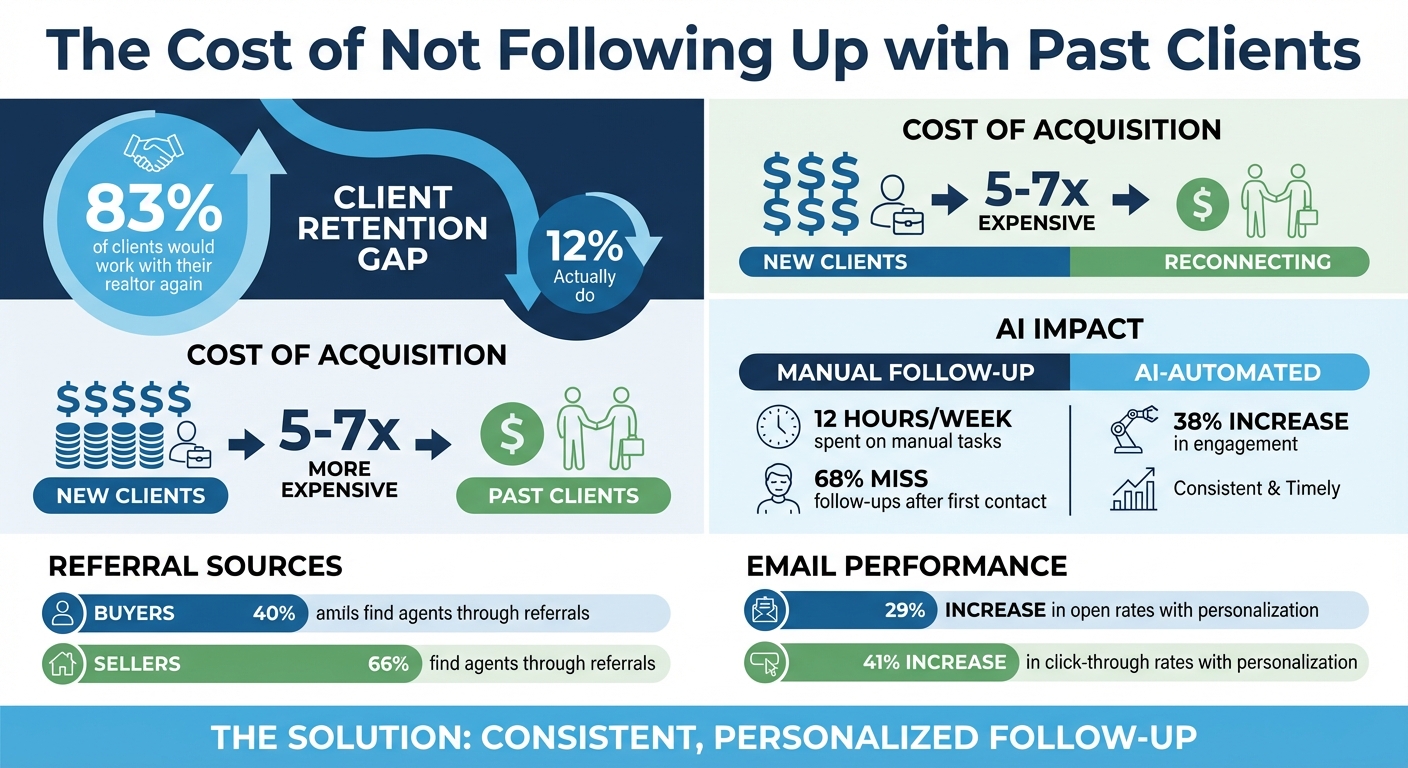
Most real estate agents miss out on repeat business and referrals simply because they don't stay in touch with past clients. While 83% of clients would work with their realtor again, only 12% actually do. Why? A lack of follow-up. Reconnecting with past clients is far cheaper than chasing new leads - it costs 5-7 times more to acquire new clients. Plus, referrals, which account for 40% of buyers and 66% of sellers finding their agents, depend on staying visible.
Here's the bottom line: Effective follow-up strengthens relationships, brings in referrals, and keeps you top-of-mind. Email is the easiest way to do it. It's direct, personal, and scalable. By referencing past conversations or milestones, like transaction anniversaries, you can stay relevant without being intrusive. Tools like KivoAI can even automate this process, saving you time while improving engagement by 38%.
If you're not following up, you're leaving money on the table. Start small: segment your contacts, personalize your emails, and track metrics like reply rates and conversions. Consistency is key - don't let competitors swoop in where you could've stayed connected.
How To Automate Real Estate Lead Follow Up - Never Miss A Deal Again
Finding Reconnection Opportunities in Your Email
Your inbox is more than just a tool for communication - it's a treasure trove of opportunities to reconnect with past clients. Every email thread holds potential clues about when someone might be ready to re-engage. The challenge lies in spotting these signals and deciding which contacts deserve your immediate attention.
Reading the Signals in Past Conversations
Some emails contain subtle signs that a client might be open to reconnecting. Take "warm ghosts", for example - these are prospects who showed genuine interest but paused discussions due to timing or budget constraints. Phrases like "let's follow up soon" or unanswered proposals shouldn't be dismissed as dead ends. Instead, they're often invitations for a well-timed follow-up.
Transaction anniversaries are another goldmine for reconnecting. A client who bought a property three months ago might be settling in now and have questions, while at the six-month mark, they could even be ready to refer someone they know. Similarly, annual check-ins are perfect for sharing updates on the market or offering home value assessments. And if a previous contact has started a new job, that's a natural, non-intrusive reason to get back in touch.
Timing is everything when dealing with clients who disengaged during earlier discussions. The length of your pause should align with where the conversation stalled. For instance, a missed call might only need a short wait, while a paused proposal may require more time. Often, the original issue still exists - it's just that their priorities shifted. Recognizing these signs can help you decide who's worth reaching out to first.
Deciding Who to Contact First
Not all reconnection opportunities are created equal. Segment your contacts by their recent activity:
- Hot (0-14 days)
- Warm (15-30 days)
- Tepid (31-60 days)
- Cooling (61-180 days)
- Cold (180+ days)
Focus your efforts on the contacts with the highest engagement and potential for closing a deal. For instance, someone who's in the decision-making phase deserves more immediate attention than a casual inquiry about market trends. High-touch, personalized outreach works best for these high-priority opportunities. By leveraging your email history, you can re-engage effectively without wasting time chasing cold leads.
Writing Reconnection Emails That Get Responses
Once you've identified opportunities to reconnect, and understood why many agents struggle to stay consistent, the next step is crafting emails that rebuild relationships and potentially revive business opportunities. The key? Make your emails personal, timely, and easy to respond to.
How to Personalize Each Message
Ditch the generic templates. If your email feels like a mass send, it's likely to be ignored. Show the recipient that you remember them and value the connection. Start with a subject line that stands out - something that offers value or piques curiosity. For instance, instead of the bland "Checking in", try "Do you still need help with [specific outcome]?" or "I've been thinking about you". Emails with personalized subject lines see a 29% increase in open rates and a 41% increase in click-through rates.
In the body, reference a specific detail from your past conversations. This small touch shows it's not just another bulk email. If it's been a while since you last spoke, briefly acknowledge the gap in a positive way. For contacts you haven't reached out to in over six months, a full reintroduction works best. For those you last spoke with 15-30 days ago, a friendly reminder is usually enough.
Keep it concise. Long emails can overwhelm busy recipients. Stick to two or three short paragraphs. End with a simple and low-pressure call to action, like a yes/no question or a link to schedule a meeting. For cold leads, the minimalist "9-word email" approach can work wonders: "Do you still need help with [outcome]?" - no fluff, no signature, just the question.
Once your email is ready, timing becomes the next crucial factor.
Email Structure and Send Timing
Timing is everything. Even the most well-written email can fall flat if sent at the wrong time. For business contacts, aim for Tuesday to Thursday mornings between 9:00 AM and 11:00 AM. Personal clients, on the other hand, often respond better on Friday through Sunday evenings, between 5:00 PM and 7:00 PM. Sending emails between 2:00 PM and 3:00 PM can also be effective, as it catches people during a post-lunch break.
"Timing is the secret sauce that separates opened emails from ignored ones." - Christian Bonnier, ListKit
If your initial email doesn't get a response, don't give up. Send follow-ups every 3-5 days to stay on their radar without being overbearing. After three attempts with no reply, consider switching to another channel, like LinkedIn or even a quick phone call. If there's still no response, it's best to remove the contact from your list to maintain your sender reputation.
Using AI to Automate Reconnection Work
When it comes to follow-ups, manual tracking can be a real time sink. Real estate agents, for example, spend an average of 12 hours per week on these tasks, and 68% miss follow-ups after the first contact due to poor tracking systems. Artificial intelligence steps in to address this inefficiency by analyzing email histories and flagging reconnection opportunities automatically. KivoAI takes this a step further by identifying the perfect timing for re-engagement.
How KivoAI Identifies When to Reach Out
KivoAI is designed to scan your inbox and spot patterns that suggest it's time to reconnect. It analyses factors like tone, response times, and how often you've interacted with a contact. From there, it scores the relationship's strength, detects shifts in sentiment that might signal a client is at risk of disengaging, and flags the best moments to reach out.
"AI analyzes email tone, response times and engagement to flag at-risk real estate clients, automate follow-ups, and boost retention." - KivoAI Team
KivoAI doesn't just stop at flagging opportunities. It builds detailed client profiles from your email history, capturing transaction details, buyer or seller status, and even key life events - all without requiring any manual data entry. Thanks to its predictive timing, KivoAI can increase engagement by 38% compared to traditional batch-sending methods.
AI Features That Speed Up Email Writing
Once a reconnection opportunity is spotted, KivoAI helps you take action quickly by drafting personalized emails. These aren't just generic templates; the AI pulls in context from past conversations, such as previous discussions, transaction history, and even specific pain points. This ensures the messages feel tailored and relevant. For instance, in December 2025, Outreach account executive Chance Fakih used an AI agent to re-engage a closed-lost opportunity with AKG Healthcare. The AI identified a stakeholder named Jade, retrieved historical deal insights, and crafted a personalized re-engagement email. This process cut the time spent per opportunity from 30 minutes to just a few seconds.
KivoAI also includes tools to adjust the tone of your emails with a single click, making it easy to fine-tune your message. Importantly, no emails are sent without your approval. You can review drafts on your phone, make quick edits, or dismiss them entirely. The platform even ensures your emails are delivered at the optimal time by automatically adjusting for the recipient's local time zone.
| Feature | Manual Tracking | AI-Driven (KivoAI) |
|---|---|---|
| Data Entry | Requires constant manual updates and logging | Automatically learns from inbox history |
| Context Retrieval | Manual search of old notes and CRM records | Automatic extraction of pain points and history |
| Follow-up Prep | Requires searching records and writing from scratch | Provides pre-drafted, contextual email threads |
| Time Zones | Requires manual segmentation by region | Automatically adjusts delivery to recipient's local time |
Tracking and Improving Your Reconnection Results
To make your reconnection emails effective, tracking is essential. Without solid data, you're left guessing which messages resonate. By analysing results, you can fine-tune your strategy and make the most of every opportunity.
Which Email Metrics to Monitor
Start by focusing on metrics that show how clients interact with your emails:
- Open rates: These gauge how compelling your subject lines are. For real estate emails, open rates typically fall between 20-40%. However, Apple's Mail Privacy Protection has made this metric less reliable.
- Click-through rates (CTR): This measures how many recipients click on links within your email. The industry benchmark is 2-5%, and it's a good indicator of genuine interest.
- Reply rates: These are the most valuable metric for reconnection emails. Even a reply rate of 0.5-2% for cold outreach shows potential, but higher rates are expected when reaching out to past clients.
- Conversion rates: These track high-value actions, such as booking a consultation or requesting a home valuation. A typical range is 1-3%.
Additionally, monitor client behaviours. For example, if a recipient re-opens your email several times over a few days, it's a strong signal to follow up. Keep an eye on list health metrics as well: aim for bounce rates below 2%, unsubscribe rates under 0.5%, and spam complaints below 0.1%. Spam complaints over 0.3% could lead to email provider blocks.
By analysing these engagement signals, you can refine your outreach and improve results.
Adjusting Your Approach Based on Data
Once you've gathered enough data, use it to tweak your strategy for better results. Timing, segmentation, and content can all be adjusted to match your clients' preferences and behaviours.
For example, if your data shows that emails sent on Sunday evenings at 8:00 PM consistently get more replies than those sent on Tuesday mornings, adjust your send times accordingly. Similarly, if a subject line like "Quick question about [neighbourhood]" generates more engagement than generic greetings, use that format more often.
Segment your contact list based on activity. Clients you've spoken with in the last 14 days (hot leads) may only need a casual nudge to keep the momentum going. On the other hand, clients you haven't contacted in 31-60 days (tepid leads) might respond better to a reintroduction email offering fresh value. If a contact doesn't engage after three email attempts, consider switching to another channel - such as LinkedIn, a phone call, or a text message. Studies show that 80% of deals require at least five follow-ups, yet many agents stop after just one or two.
Keep your email list clean by removing hard bounces immediately and scrubbing inactive subscribers (those who haven't engaged in 90+ days). This protects your sender reputation and ensures you're focusing on contacts with real potential. Finally, test one variable at a time - whether it's subject lines, call-to-action placement, or send times. This approach helps you identify what works best for your audience. Over time, these small, consistent adjustments can lead to noticeable improvements in your results.
Conclusion: Stay Connected, Win More Business
A strong follow-up process can turn missed chances into consistent revenue streams. Here's an important fact: reaching out to a past client is much cheaper than finding a brand-new one. Yet, while 83% of clients claim they'd work with their realtor again, only 12% actually do. Why? Often, it's because the agent didn't maintain regular contact.
The secret lies in being consistent without overwhelming your clients. Email is a great tool for this - it makes relationship marketing both measurable and scalable. However, consistency can be challenging without a system that fits seamlessly into your daily routine. Manual methods often involve tedious data entry and constant switching between tasks, which can derail even the best intentions.
This is where tools like KivoAI come into play. By analysing your email conversations, KivoAI identifies key moments for outreach and creates personalized messages that include client details and past conversations. Everything is delivered straight to your inbox - no need for separate dashboards or manual tracking.
"The best follow-up system is the one you'll actually use. Everything else is just features." - KivoAI Team
Using relationship intelligence transforms your inbox into a proactive pipeline, fostering trust with every interaction. Consistent follow-up builds that trust into repeat business. By offering real value instead of constant sales pitches, you create goodwill that leads to natural conversions over time. Automated, personalized emails perform much better than manual ones, but only when they feel timely and relevant. That's the edge relationship intelligence provides, making your inbox a powerful tool while you focus on closing deals.
FAQs
Tags
Ready to fix follow-up?
Try inbox-first relationship management free for 14 days. No credit card required.
Start Free Trial